Your first car: used, new or luxury? An honest guide for young buyers
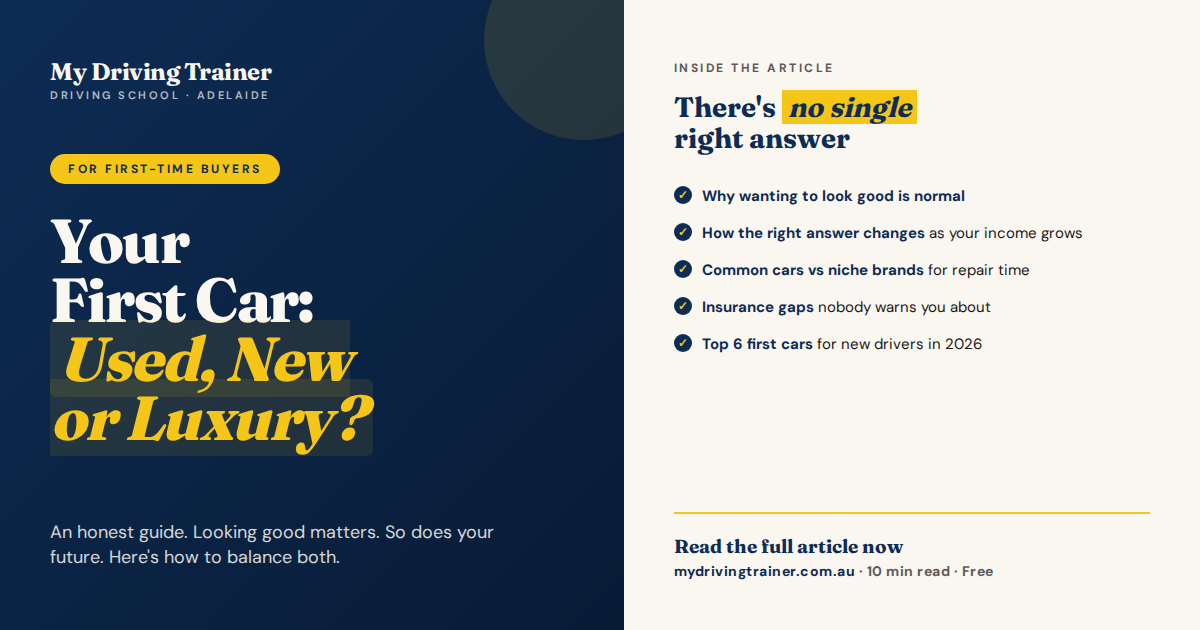
There is no single right answer to this question. The right car depends on your income, your job security, your situation, and even your social life. This guide walks through the trade-offs honestly. The goal is not to talk you out of any choice, but to make sure you understand the full picture before you sign anything.
Important. This article is general information only and reflects opinions based on widely reported industry data. It is not financial advice, legal advice, insurance advice, or tax advice. Markets, prices, depreciation rates, finance rates, insurance terms and tax rules all change over time. What is true today may not be true in two years. Always speak to a qualified financial adviser, accountant, or licensed broker before making a major purchase decision, and read the Product Disclosure Statement of any insurance product before buying.
First, let's be honest about wanting to look good
If you are in your late teens or twenties and you want a car that looks good when your friends see it, that is a completely normal human feeling. Wanting acceptance and admiration from your peer group is part of how all of us are wired. Anyone who tells you that wanting to look good is shallow or wrong has either forgotten how that feels, or is lying to themselves.
The honest truth is more nuanced. The car you drive does affect how people see you in the short term. It is a real social signal, especially in your early twenties. We are not going to pretend otherwise.
The question is not whether looking good matters. It does. The question is what you trade away to get there, and whether that trade still feels worth it in five years.
How the trade-off actually changes over time
This is the part most "just buy a Corolla" articles miss. The right answer changes with your life stage and your income security.
At 18 to 24
Your income is usually low or unpredictable. You may be studying, in your first job, or moving between roles. A car payment of $600+ per month is a much bigger share of your income than it will be at 35. A breakdown of your car can wipe out a month's savings. Your buffer is thin.
At this stage, the maths usually favours a reliable used car. Not because looking good is wrong, but because financial fragility at this age can derail bigger goals (saving for a house deposit, moving out, travel, education). One bad month with an expensive car can take a year to recover from.
At 25 to 35
Income usually rises. Job security usually improves. You have a buffer. If you are earning $80K+ stably, a modest luxury car becomes less risky. The same $600/month payment now represents a smaller share of your income.
At this stage, the trade-off shifts. A nicer car can be both a reward and a sensible purchase, if your income and savings can absorb the worst case (lost job, illness, market downturn).
At 35+
If you have established income, savings, and assets, you can afford whatever car you genuinely want. The "boring sensible car" advice was never permanent. It was advice for a specific stage. As your situation changes, the right answer changes.
The actual numbers on new vs used vs luxury
New cars
The widely reported pattern is that new vehicles often lose 10 to 20% of their value when they leave the dealer's lot, and many lose around 60% of their value within five years. Your $30,000 car can be worth $12,000 by year five. These figures are industry-wide averages and vary heavily by brand and model.
However. If you can afford the new-car payment without stress, the loss of resale value matters less. Some buyers prefer warranty, fixed-price servicing, the latest safety tech, and the simple fact that the car has no history. Those are real, legitimate reasons.
Luxury cars
Industry reports suggest luxury vehicles, particularly some European luxury models and many luxury EVs, depreciate faster than mainstream brands. Some analyses indicate luxury vehicles can lose 60 to 72% of their value within a few years.
On top of depreciation, Australia adds Luxury Car Tax (LCT) at 33% on the amount above the threshold (around $80,567 for petrol/diesel vehicles, around $91,387 for fuel-efficient vehicles in the 2025-26 financial year). Always confirm the current thresholds with the ATO before purchase, as these can change yearly.
The honest summary: luxury cars cost more to buy, more to insure, more to service, and lose value faster. If your income and savings can absorb that, fine. If not, the financial pressure can outweigh the social benefit faster than you expect.
Used cars (1 to 5 years old)
For many first-time buyers, used cars offer better value because the previous owner has absorbed the steepest depreciation. The car is still modern, often still under warranty, and 30 to 50% cheaper.
The 2025 Used Car Safety Ratings guide (compiled by the Monash University Accident Research Centre) reports that many high-safety used vehicles are available for under $25,000, and more than half of the "Safer Pick" vehicles are priced below $10,000.
Parts availability and repair time, the part nobody talks about
Here is something that doesn't show up in glossy car ads: not all cars are equal when it comes to getting parts and getting repaired quickly. This matters more than you'd think, especially if you rely on your car to get to work.
Common cars = common parts = short wait
Toyota, Mazda, Honda, Hyundai, Kia, Mitsubishi, and Suzuki are some of the best-selling brands in Australia. That means:
- Parts are usually in stock at multiple suppliers, dealerships, and aftermarket retailers
- Most mechanics know these cars inside out, so labour costs and diagnostic times are lower
- Repair turnaround is typically days, not weeks for common faults
- Used parts and aftermarket parts are widely available, giving you cheaper repair options
Luxury, niche, and imported cars
European luxury brands, some EVs, and lower-volume imports can take longer to repair, sometimes weeks or months. Why?
- Parts often need to be ordered in, sometimes from overseas
- Fewer mechanics are trained on these vehicles, especially outside major cities
- Specialised diagnostic equipment may be needed
- Even minor parts cost more because they are not produced in volume
If you are looking at a car where the brand is uncommon or the model is being phased out, ask the dealer two questions before signing:
- "What is the average wait time for parts on this model?"
- "How many service centres in this state can repair it?"
The backup plan: insurance, hire cars, and what's actually covered
This is the bit most buyers learn the hard way. Standard car insurance in Australia, including Comprehensive insurance, generally does not cover mechanical breakdowns caused by wear and tear or lack of maintenance. If your engine fails on the way to work, your insurer is typically not paying for it.
Specifically, most policies commonly exclude:
- Mechanical, structural, electrical, or electronic failures
- Engine failure not caused by an accident
- Brake failure, considered a maintenance issue
- Damage from driving an unroadworthy vehicle
- Wear and tear (tyres, belts, batteries, etc.)
What is generally covered: damage from insured events like accidents, theft, fire, storms, and vandalism.
Always read the Product Disclosure Statement (PDS) of any insurance policy carefully. Cover varies between insurers and products, and the exclusions list is where the surprises live.
The hire car / loan car question
If your car is in the shop for two weeks, how do you get to work? This is where having a plan matters. Common options to investigate:
- Accident hire car add-on (insurance): Many Comprehensive policies offer a hire car add-on for an extra premium. Important: this usually only triggers after an accident, not a mechanical breakdown. Confirm exactly what triggers the hire car cover in the PDS before relying on it.
- Manufacturer loan car: Some dealerships offer loan cars during scheduled servicing or warranty repairs. Ask before you buy if this is included.
- Roadside assistance package: Adding roadside assistance (RAA in SA, NRMA in NSW, RACV in Victoria, etc.) typically covers towing and emergency repairs. Some premium packages include short-term loan cars or accommodation if you are stranded far from home.
- Extended warranty / mechanical breakdown insurance: A separate product from car insurance. Some new cars come with this for the first few years. Used buyers can purchase it. Read the fine print: it typically doesn't cover wear and tear.
- Backup transport plan: Public transport, lifts from family or friends, a partner's car, ride share, or a bicycle. Have at least one option ready.
If you have income security, you can afford to be different
If you have a stable, well-paying job with predictable income, an emergency fund of at least three to six months of expenses, and no other major debts, you have more flexibility than someone who doesn't. You can absorb depreciation. You can afford higher insurance. You can ride out a longer repair if something breaks.
This is not just about money. It is about your capacity to take a hit and bounce back. Buyers with that capacity have earned the right to choose a car that makes them happy, even if it isn't the most "logical" choice.
The advice that often gets criticised in personal finance ("you can't afford that BMW") is really about matching the purchase to your financial buffer, not about denying anyone the right to enjoy what they've earned.
Wants vs needs by life stage and income (general guidance only)
The figures and ranges below are illustrative only, based on widely reported pricing in the Australian market in 2026. They are not personalised advice. Your circumstances are unique.
Lower / variable income (under $40K) or casual employment
Priority: Reliability, low running costs, easy parts availability.
Often suitable: A 5 to 10 year old Toyota Corolla, Mazda 3, Honda Civic, Hyundai i30, or Kia Cerato. Typically $8,000 to $15,000. Parts are everywhere. Most mechanics know them.
Watch out for: Cars from brands you've never heard of, even if they look like a bargain. Cheap parts and cheap mechanics matter most when your buffer is thin.
Stable income ($40K–$80K)
Priority: A balance of nice-to-drive, reliable, and affordable to insure.
Often suitable: A 2 to 4 year old Toyota Corolla, Mazda CX-3 or CX-30, Kia Cerato, Hyundai i30, or Honda HR-V. Typically $18,000 to $28,000. If financing, shorter terms (3 to 4 years) usually cost less in interest than 7-year loans.
Mentor flag: Get insurance quotes before you buy. Insurance for under-25 drivers on sportier or luxury models can be triple the rate of a sensible hatchback.
Strong income ($80K–$150K) with savings buffer
You can stretch. Entry-level luxury (Lexus UX, Audi A3, BMW 1 Series, Mercedes A-Class) becomes more viable. Just understand the trade-offs in parts cost, insurance, and depreciation.
Alternative: A higher-trim mainstream car (Mazda CX-5 GT, Toyota RAV4 Hybrid Cruiser) that delivers near-luxury comfort without the luxury depreciation curve.
$150K+ with established savings
You have genuine flexibility. Buy what you want, within reason. The honest test: can you write the cheque without affecting your retirement plan, your kids' future, or your investment goals? If yes, enjoy it. If no, you probably can't quite afford it yet.
Top first cars for new drivers in 2026
These come up repeatedly in independent reviews and used-car data for Australia. Common parts, common mechanics, reliable reputation.
- Toyota Corolla. Australia's most trusted small car. Reliable, safe, low running costs. Parts available everywhere.
- Mazda 2 / Mazda 3. Compact, light, perfect for city driving. Easy parking, lower insurance category, parts widely stocked.
- Hyundai i30. Slightly larger but still easy to control. Strong fuel economy. Good visibility for new drivers.
- Kia Cerato. Practical sedan or hatchback. Modern safety, capped-price servicing in early years.
- Suzuki Swift. Budget-friendly, fuel-efficient, light and nimble.
- Honda Civic / HR-V. Strong reliability reputation, easy to service, holds value reasonably well.
All of these are "common cars" in Australia, meaning spare parts are usually in stock, mechanics are familiar with them, and repair turnaround times are typically shorter than with niche or imported brands.
The 5 things that actually matter for a first car
- Safety rating. Look for 4-5 star ANCAP, or check the Used Car Safety Ratings guide for older models.
- Insurance cost. Get quotes before buying. The same car can cost wildly different amounts to insure depending on age, postcode, and excess.
- Parts availability and repair turnaround. Common cars = lower stress when something breaks.
- Total running cost, not just sticker price. Fuel, insurance, rego, servicing, tyres. Mainstream brands typically win on total cost.
- Whether it fits your life. A two-door sports car is fun until you need to move house, fit a baby seat, or carry three friends.
The 5 things that don't matter as much as you'd think
- The badge alone. A Toyota and a Lexus are made by the same company. The Toyota costs half as much and has near-identical reliability.
- Power. P-platers in most states can't drive high-powered cars anyway. And powerful cars in inexperienced hands crash more.
- Other people's opinions long term. Your friends notice the new car for about three weeks. Then they stop noticing. The financial pressure of that car can last seven years.
- Resale "investment" claims. Almost no daily-driven car appreciates. Only specific collectible models do, and they aren't your first car.
- New-car smell. Lasts six weeks, costs up to $15,000.
Final word, honest and balanced
Wanting a nice car is normal. Wanting to look good in front of your friends is normal. There is nothing wrong with either. The only honest message we can offer is this:
Match the car to your financial buffer, not your aspirations. If your income is stable, your savings can take a hit, and the repayments don't keep you up at night, buy whatever makes you happy. If any of those things aren't yet true, a sensible common-brand car bought used will free up money to build them. Once you have the buffer, you've earned the right to upgrade. Patience pays a real dividend.
Whatever you choose, before you sign anything, do these five things:
- Get at least three insurance quotes
- Check Used Car Safety Ratings or ANCAP
- Ask the dealer about parts availability and average repair times
- Have a clear backup transport plan for the day your car is off the road
- Read the PDS of any insurance, warranty, or finance product before signing
Just got your L's or P's? Before you buy a car, make sure you can drive it confidently. We offer assessment sessions for new and experienced drivers across Adelaide. Book your assessment today.
Sources and references: Australian Taxation Office (Luxury Car Tax thresholds 2025-26); 2025 Used Car Safety Ratings Guide (Monash University Accident Research Centre / Towards Zero NSW); ANCAP Safety Ratings; Allianz Australia, Budget Direct, Finder Australia, National Cover Insurance (insurance exclusion summaries and mechanical fault cover commentary); CarExpert, OnlineAuto.com.au, CarHelper.com.au (Australian car wait time and stock data). Pricing ranges and figures are illustrative and based on publicly reported market data at the time of writing.
Important disclaimer. This article is general information and editorial commentary for educational purposes only. It is not financial advice, legal advice, insurance advice, tax advice, or a recommendation to buy or sell any particular vehicle, insurance policy, or financial product. My Driving Trainer is a driving school. We are not licensed to provide financial advice or insurance advice. Markets, prices, depreciation rates, finance terms, insurance terms, and tax thresholds all change over time and may differ significantly from what is described here. Before making any major financial decision, please consult a qualified, licensed financial adviser, accountant, or insurance broker who can assess your individual circumstances. Always read the relevant Product Disclosure Statement before purchasing any insurance product. Your circumstances and goals are unique to you.